
Article
How to Make French Press Coffee: A Simple Beginner Method
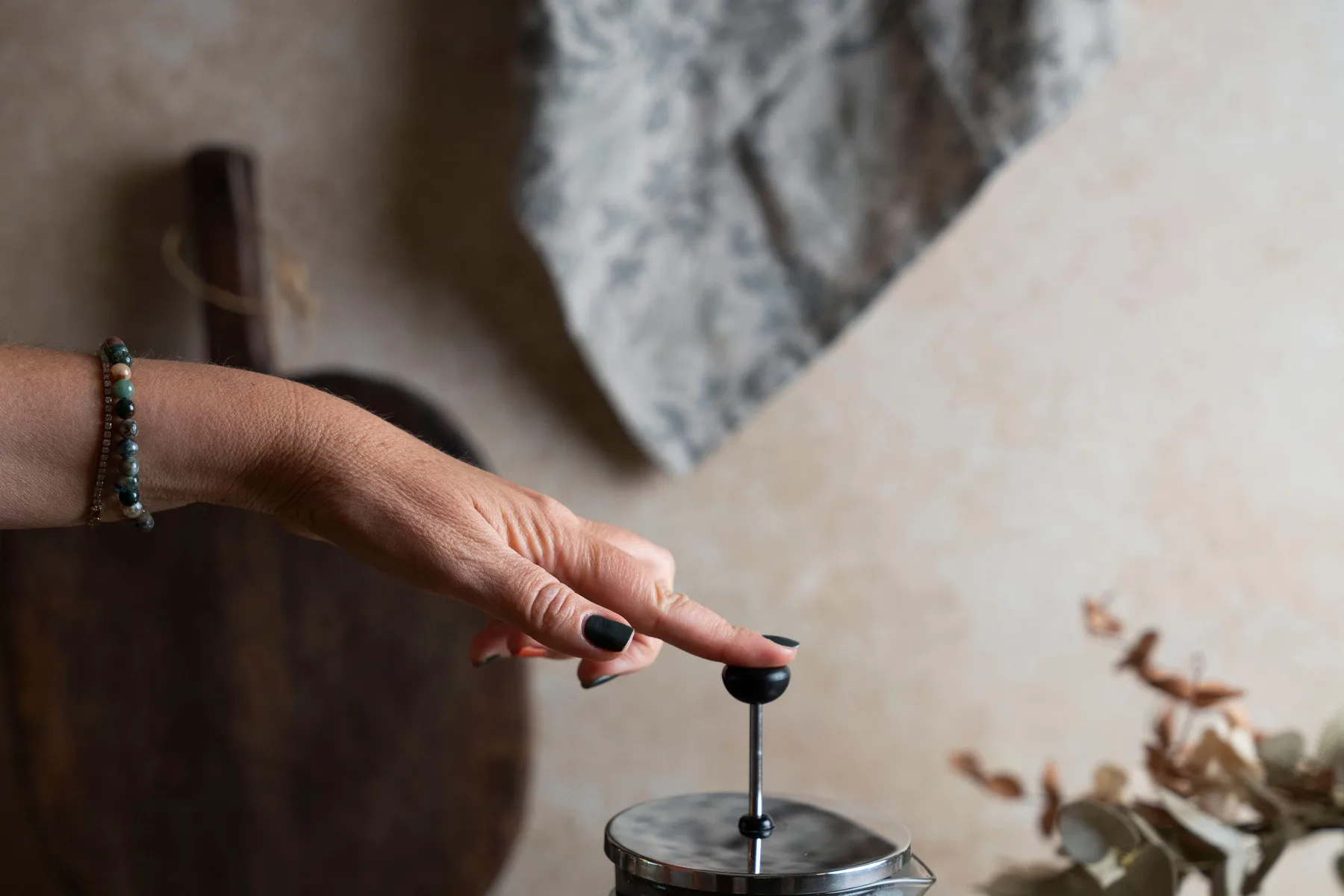
Coffee Made Clear French Press Baseline
- Coffee
- 20 g
- Water
- 300 g
- Ratio
- 1:15
- Grind
- medium-coarse starting range
- Water temperature
- hot, off-boil
- Pours
- about 65 g, stir, wait about 30 seconds, then the rest (300 g in all)
- Agitation
- gently stir after each of the two pours
- Steep
- about 6½ minutes from the first pour to the plunge
- Finish
- press steadily, pour, taste
- Researched — Hands-on testing has not been completed for this page; it reflects research and category best practices.
- Report a correction — fixes are logged in the Updated date.
French press is one of the simplest ways to make coffee because most of the brewing happens during a steep rather than through a carefully managed pour. The grounds sit in the water, then a plunger and metal mesh separate most of the grounds from the drink.
The part that confuses beginners is that recipes disagree. One source says four minutes. Another lands around six and a half. Ratios vary. Grind advice varies. That does not mean French press is impossible to get right. It means there is no reason to pretend one recipe is a universal law.
This guide gives you one clear place to start.
Quick answer: the Coffee Made Clear French Press Baseline
Start with:
- 20 g coffee
- 300 g water
- 1:15 coffee-to-water ratio
- medium-coarse grind
- hot, off-boil water
- two pours (about 65 g, then the rest), stirred gently after each
- about 6½ minutes from the first pour to the plunge
- press steadily, then pour
This is a beginner baseline, not a scientifically proven optimum. The 20 g / 300 g ratio is an exact scale-up of a Prima Coffee Equipment French Press Brewing Guide using 17 g coffee and 255 g water, which is exactly 1:15. That source also specifies medium-coarse coffee and instructs plunging when the timer reaches about 6:30. It pours in two stages (55 g, then 200 g) and stirs after each; the pour sizes here scale those amounts by the same factor.
Other legitimate procedures use different numbers. A peer-reviewed 2023 study’s hot French-press comparator used 60 g coarse coffee, 720 g off-boiling water, gentle stirring, a 10-minute steep, and then plunging. That is useful evidence that French-press methods vary; it is not a reason to copy that research procedure as your everyday recipe.
What you need
You need:
- a French press
- coffee
- hot water
- a scale if available
- a grinder if you grind at home
- a timer
A scale makes repeatability much easier because you can keep coffee and water constant from one brew to the next.
If you do not own a grinder, pre-ground coffee can still be used. The important thing is to avoid pretending one grinder setting or one particle size works for every coffee and every French press.
Step 1: Measure 20 g coffee and 300 g water
The Coffee Made Clear baseline uses 20 g coffee to 300 g water, which is a 1:15 ratio.
For comparison, Specialty Coffee Association educational material describes 60 g of coffee per liter of water as a common brewing-ratio expression for drip and immersion coffee. That works out to about 1:16.7.
So 1:15 is not the only reasonable French-press ratio. It is simply the ratio used for this baseline because it scales cleanly from the Prima Coffee Equipment recipe.
If you later want a lighter or stronger cup, ratio is one of the variables you can adjust. Change it deliberately rather than guessing with scoops.
Step 2: Start with a medium-coarse grind
Use medium-coarse as your starting neighborhood.
Our Coffee Grind Size Chart lists French press as coarse, following Baratza and Breville. The Prima Coffee Equipment recipe this guide follows starts one step finer, at medium-coarse. We start from Prima’s setting because this recipe is built on it; coarse is the next step on the chart if you later decide to change the grind.
This guide starts at medium-coarse because it follows the Prima Coffee Equipment French Press Brewing Guide, which specifies Medium-Coarse. The sources behind our grind chart say coarse, and separate coffee-extraction research documents coarse-ground French-press methods, so medium-coarse is not a universal label. Particle size matters because it changes extraction behavior, and finer particles generally allow faster extraction under controlled immersion conditions.
But “coarse” is still a range, not one exact grinder number. Grinder scales are not universal, and beans, roast, equipment, and brew conditions differ.
So do not copy a grinder setting from someone else’s machine and assume it is a scientific standard.
Step 3: Pour in two stages and stir gently
Start your timer and pour about 65 g of hot water over the coffee, then stir gently. After about 30 seconds, pour in the rest, about 235 g, so you have used 300 g in all, and stir gently again. Put the plunger on top without pressing it.
This follows the Prima Coffee Equipment recipe, which pours 55 g, stirs, waits 30 seconds, pours 200 g, stirs again, and sets the plunger on top. The 65 g and 235 g here are those amounts scaled by the same factor as the coffee and the total water.
For this baseline, think hot/off-boil, not “one perfect temperature.” A peer-reviewed French-press comparator used off-boiling water, but that does not establish one universal optimum for every coffee.
Gentle stirring is a documented procedure in the 2023 French-press method, but this guide does not claim that a particular stir count, direction, or intensity is required for better flavor.
The goal here is consistency, not choreography.
Step 4: Steep for about 6½ minutes
Let the coffee steep until your timer, started at the first pour, reads about 6½ minutes.
Why about six and a half?
Because the Prima Coffee Equipment French Press Brewing Guide instructs plunging when the timer reaches about 6:30 and specifies a Medium-Coarse grind and a 1:15 ratio.
Why not call six and a half minutes “correct”?
Because other credible procedures differ. The peer-reviewed French-press comparator discussed above used a 10-minute steep.
That is exactly why this article calls about six and a half minutes a starting point rather than a rule.
You may eventually prefer a different time with your coffee, grind, ratio, and desired cup. Keep the rest of the recipe stable while you test changes.
Step 5: Press steadily
After the steep, place the plunger correctly and press it down steadily to separate the beverage from most of the grounds.
You do not need to turn the plunge into a speed contest. This guide does not claim there is one ideal number of seconds or one correct amount of pressure.
If the plunger feels unusually difficult, that can be a clue that your grind is finer than expected or that fines are creating resistance—but treat that as a troubleshooting clue, not a diagnosis.
Step 6: Pour and taste
Once pressed, pour the coffee and evaluate the cup. Coffee Made Clear treats this as the end of the simple steep-and-separate workflow.
The key is not to decide whether your first attempt is “right” or “wrong.” Instead ask:
- Is the strength where I want it?
- Is the cup harsher or thinner than I prefer?
- Did the brew behave differently than expected?
- What one variable should I test next?
The Coffee Made Clear one-change rule
French press has several real controls:
- grind
- ratio
- water temperature
- steep time
- agitation
- separation timing
These variables interact.
So if the cup is not where you want it, do not change the dose, grind, steep time, and water all at once.
Change one thing. Brew again. Compare.
That is slower than randomly changing everything, but it actually teaches you what your adjustment did.
If your French press tastes weak
Weakness can come from more than one cause, so do not diagnose it from flavor alone.
Your first controlled tests might include:
- using a little more coffee for the same water
- testing a slightly finer grind
- extending the steep modestly
Choose one of those, not all three at once.
If your French press tastes too strong
Strength and extraction are not the same thing, and a strong cup is not automatically “over-extracted.”
If the beverage is simply stronger than you prefer, the most direct first test is usually the recipe ratio: use a little less coffee for the same water or more water for the same coffee. Then evaluate again.
The important boundary is the same: one taste impression does not prove one cause.
If it tastes harsh, rough, or drying
Do not jump straight to “the coffee brewed too long.” Grind, ratio, roast, water, temperature, and time can all contribute to what you perceive.
A useful first test is to move slightly coarser or shorten the steep while keeping other variables stable. Treat that as troubleshooting, not diagnosis.
Does French press have to use medium-coarse coffee?
This guide starts at medium-coarse because it follows the Prima recipe; the sources behind our grind chart say coarse. Medium-coarse is a starting neighborhood, not a universal law.
The Prima Coffee Equipment recipe specifies Medium-Coarse coffee. Separate coffee-extraction research also shows why particle size matters: smaller particles generally extract more rapidly under controlled conditions.
What this guide does not claim is that every French press must use medium-coarse coffee.
Start medium-coarse. Then adjust intentionally.
Does French press have to brew for four minutes?
No universal four-minute requirement is established by the research behind this guide.
The Prima Coffee Equipment recipe used here instructs plunging when the timer reaches about 6:30, while the peer-reviewed French-press comparator used a 10-minute steep.
That does not make four minutes “wrong.” It means the evidence does not support presenting one time as mandatory across every coffee and recipe.
For this guide, about 6½ minutes to the plunge is the baseline.
Should I use a 1:15 or 1:16.7 ratio?
Both can be useful starting references.
- 1:15 is the Coffee Made Clear baseline because it scales directly from the Prima Coffee Equipment French-press recipe.
- ~1:16.7 is a broader SCA reference ratio used in drip and immersion discussion.
If you are learning, the bigger win is consistency: pick one baseline, measure it, then adjust from there.
French press vs pour-over: the practical difference
French press is primarily a steep-and-separate immersion process. Pour-over is primarily an active flow-through process.
That makes French press a good fit for someone who wants fewer active pouring decisions during the brew. It does not make French press objectively easier or better. Our guidance avoids that universal ranking.
If you want to try the other method, see How to Make Pour-Over Coffee.
Save this recipe
Coffee Made Clear French Press Baseline
Coffee: 20 g
Water: 300 g
Ratio: 1:15
Grind: medium-coarse starting range
Water: hot/off-boil
Pours: about 65 g, stir, wait about 30 seconds, then the rest (300 g in all)
Agitation: gently stir after each of the two pours
Steep: about 6½ minutes from the first pour to the plunge
Finish: press steadily, pour, taste
Adjustment rule: change one variable at a time
This recipe is an editorial starting point built from documented recipe and research evidence. It is not presented as the one correct French-press method.
Bottom line
A good beginner French-press routine does not need a dozen precision rules.
Measure your coffee and water. Start medium-coarse. Pour in two stages, stirring gently after each. Steep until about six and a half minutes from the first pour. Press. Pour. Taste. Then change one thing if you want a different result.
The most important skill is not memorizing a “perfect” recipe. It is learning which variable you changed and what happened next.
Sources
Studies and pages used for the claims above. This guide is research-based and does not claim hands-on product testing.
- Prima Coffee, French press brewing guide.
- Wang and Lim, Effects of grind size, temperature, and brewing ratio on immersion cold brewed and French press hot brewed coffees, Applied Food Research (2023).
- Wang et al., Effects of capsule parameters on coffee extraction in single-serve brewer, Food Research International (2016).
- Specialty Coffee Association, Water and Coffee Acidity: How to Adapt Your Water for Different Extraction Methods.